DAPPEr Gets its Wings
DAPPEr Accepted by CubeSat Launch Initiative
Students awaited a fateful four months for a response from NASA after
submitting their CubeSat Launch Initiative (CSLI) proposal. On Monday, March 18,
2024, team DAPPEr received its acceptance into CSLI solidifying their spot for a
3U CubeSat to go to space!

With a desire to lead Delaware’s first orbital satellite mission, students at the University
of Delaware convened in the DSpOC Lab in the fall of 2023 to come up with their
mission: the Delaware Atmospheric Plasma Probe Experiment (DAPPEr). DAPPEr will be a
3U CubeSat, a standard type of satellite that is about the size of a shoebox (4”x4” length
by width and about 12” tall). This mission was immediately put to paper for a proposal to
NASA. From top-level objectives to design requirements, team DAPPEr had to present a
well-formed mission to NASA in order to be one of the missions selected for this year’s
CSLI. In a span of under 4 months: the student team formed, completed background
reading and defined mission objectives, conducted two reviews with experts in orbital
missions, and finally submitted the mission proposal to NASA.
There are 13 students on team
DAPPEr, consisting of 12
undergraduates and 1 graduate
student. There are 5 unique disciplines
making up the team, including: Physics
and Astronomy, Mechanical
Engineering, Electrical Engineering,
Computer Engineering, and Biomedical
Engineering. These students are
divided into sub-teams for Mechanical,
Electrical, Software, and Science tasks.
Two mentors oversee design and
development of the mission.
| Member Name | Discipline |
|---|---|
| Amanda Swenson | Physics & Astronomy |
| Alex Bruce | Physics & Astronomy |
| Timothy “TJ” Tomaszewski | Physics & Astronomy |
| Jarrod Bieber | Physics & Astronomy |
| Marisol Catalan Olais | Physics & Astronomy |
| Samuel Auerbach | Mechanical Engineering |
| Connor McCleery | Mechanical Engineering |
| Jonathan Rosado | Mechanical Engineering |
| Markos Duey | Mechanical Engineering |
| Matthew Ward | Electrical & Computer Engineering |
| Ranyah Khan | Electrical & Computer Engineering |
| Sreenidhi Banda | Biomedical Engineering |

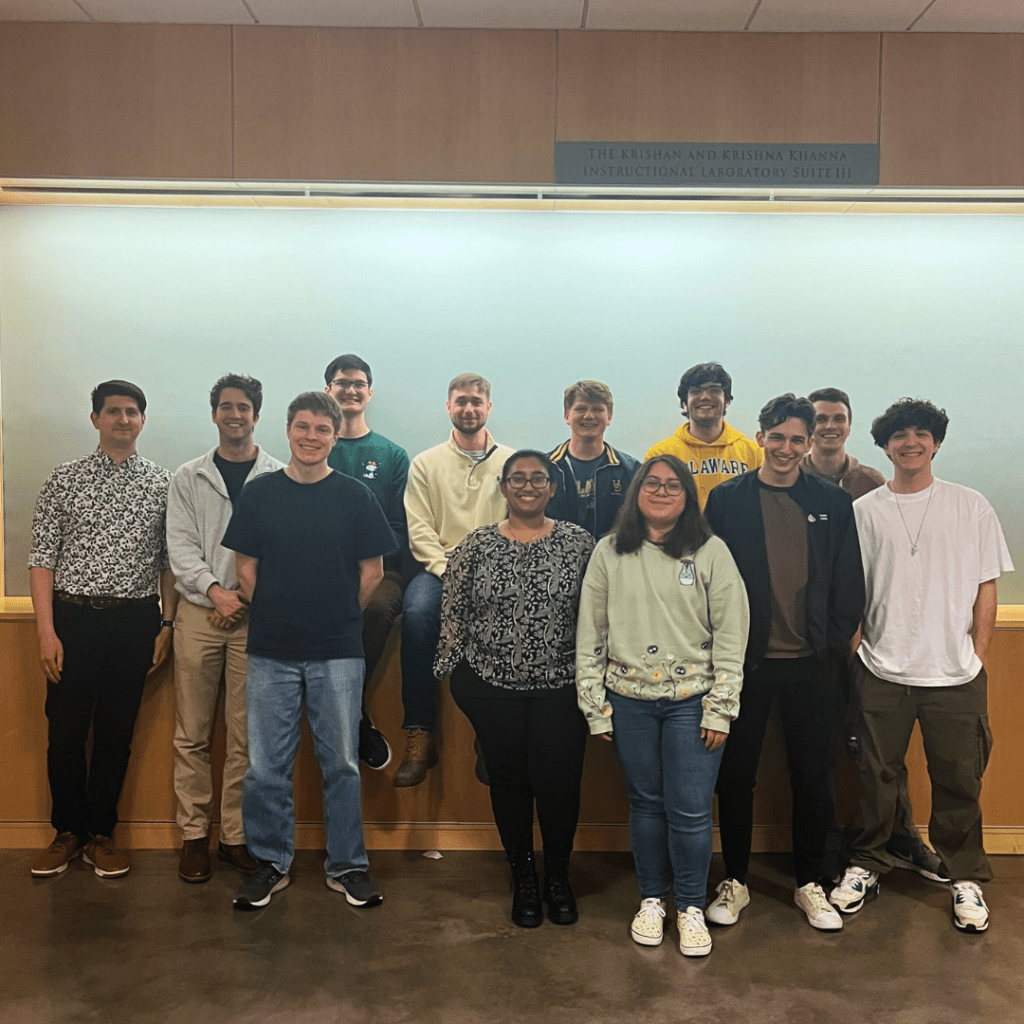
The DAPPEr team photo.
The primary goal of DAPPEr is the education of students. Delaware students are truly
leading the mission by picking out parts, designing printed circuit boards, testing and
integrating hardware, developing software, and giving presentations. They are the experts
in the mission; there is no one else telling them what to do. It is up to them to come up
with the plan and execute it. DAPPEr students will come out of the project with
impressive experiences and invaluable skills.
The secondary goals of DAPPEr are scientific and technological. The scientific instrument flying on DAPPEr, the “Plasma Probe,” or “PP” of DAPPEr, is a Langmuir probe. This type of instrument will be used on DAPPEr to determine the density and temperature of electrons in the ionosphere. The ionosphere resides from about 60km to 800km (40mi to 500mi) above Earth’s surface and contains charged particles. If you insert a conductive material, also known as a Langmuir probe, into this environment, you can “collect” the nearby charged particles. Analyzing the collection data reveals the temperature and density of those particles. The ionosphere is a constantly changing portion of the atmosphere, so collecting this data over time provides insight into how the particles change
Now the real fun begins for team DAPPEr. A flight on-board the RockSat-C sounding
rocket will provide a proximate test for many of the systems that will be used in DAPPEr,
including the Science Board, Flight Computer, and Power Supply. This launch will occur
next month, currently scheduled for Thursday June 20, 2024. With the data from this
mission, DAPPEr will make changes and improvements to the electronics as needed. After
the launch, the team will begin procuring the satellite-specific parts, like the chassis, which
contains all the electronics, the solar panels, and the Attitude Determination and Control
System (ADCS). Expected delivery of the completed 3U satellite is end of year 2025 for a
launch in 2026.
 Delaware Space Observation Center
Leave a comment