First Use of the Thermal Vacuum Chamber
Exploring Our New Lab
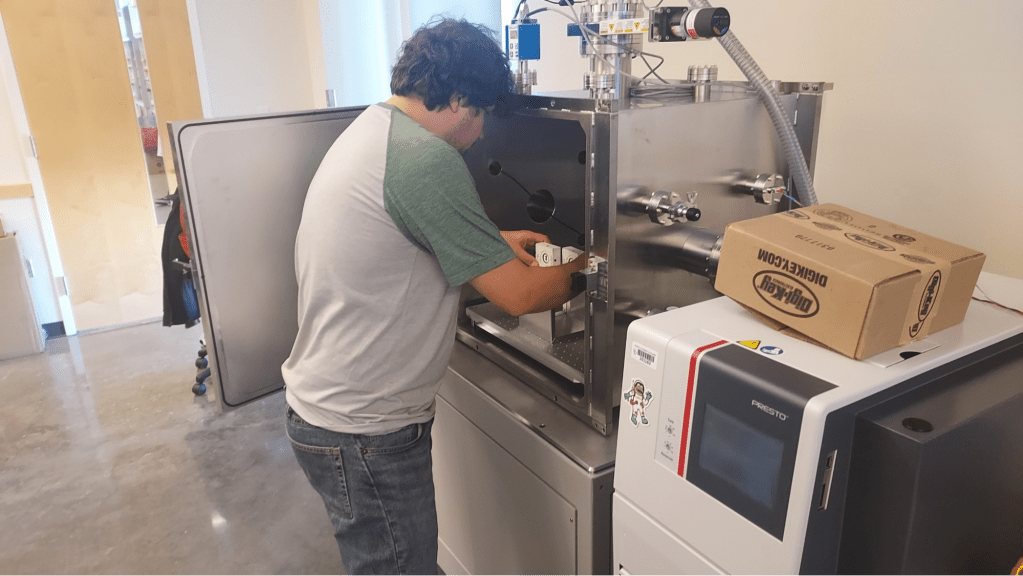
October 13, 2023 marked the first use of DSpOC’s new state-of-the-art thermal vacuum chamber. This chamber is meant to serve as a space simulator, creating an environment similar to that of space. The two main aspects that the chamber controls are pressure and temperature. In space, a low pressure environment is created by the extremely low density of particles. Temperature is a huge concern in space due to the low pressure, since, on Earth, the atmosphere handles much of the heat dispersion. When something is hot, the air molecules around it are able to take some of the heat away. In space, there is virtually no “air,” and heat can build up on components. Likewise, things becoming too cold in space is another concern. Heat regulation is paramount to success in space, and is especially difficult to model and test on earth. That is the strength of the thermal vacuum chamber.
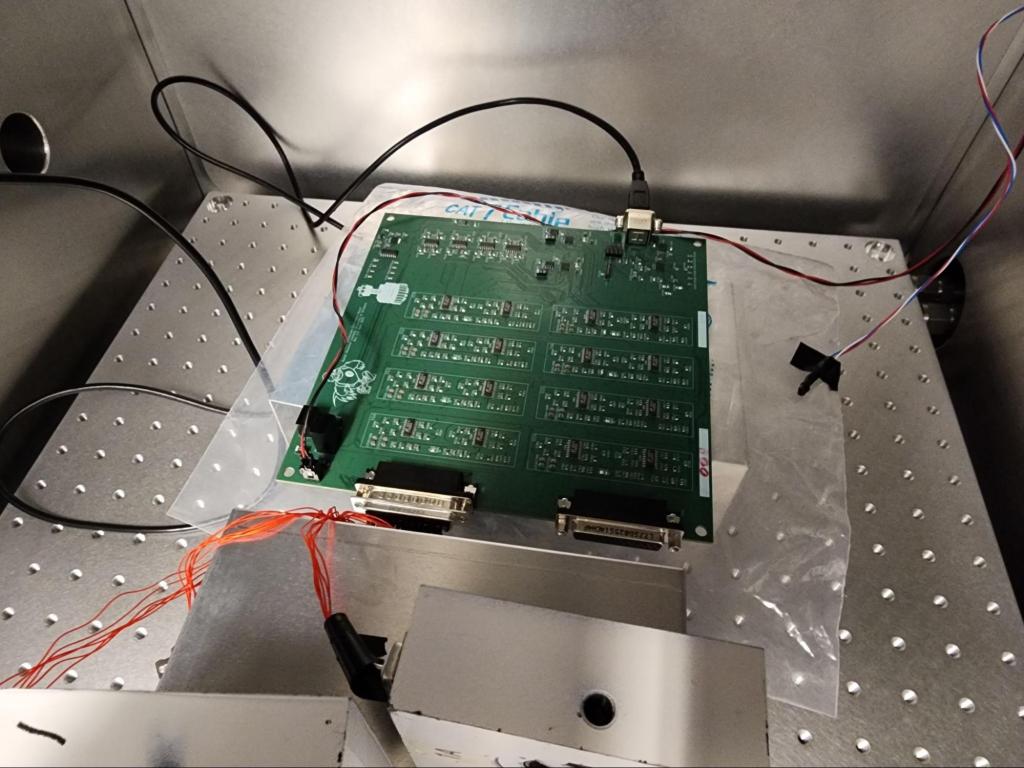
Dr. Quincy Abarr and Dr. Alexander Novikov from the department of Physics and Astronomy tested electronics which are part of the balloon-borne mission PUEO (Payload for Ultrahigh Energy Observations), a joint collaboration between many universities around the world which is led by Abigail Vieregg at the University of Chicago. PUEO will launch their payload from McMurdo Station, Antarctica in December 2025. The main goal of the experiment is to make the first detection of ultrahigh-energy neutrinos at energies above 1 EeV, and the University of Delaware group is leading the development of the navigation/orientation subsystem.This includes the sun sensors, which determine the direction towards the sun and use that to derive the orientation of the payload. Dr. Novikov developed the readout electronics for the sun sensors, and to ensure the components will survive sub-freezing temperatures and low pressures these electronics must be tested in the thermal vacuum chamber. The first results were successful, and the team is looking forward to more detailed studies of their equipment.
 Delaware Space Observation Center
Leave a comment