Delaware State University’s Voyage Scale-Model Solar System
A new planetary exhibition has been installed permanently on the campus of Delaware State University.
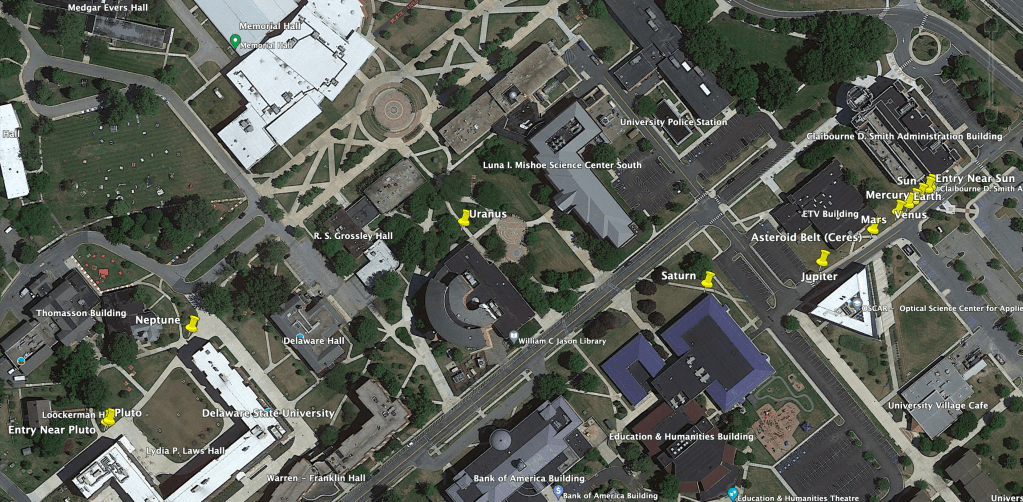
The Voyage Scale Model Solar System—eleven separate stations representing the sun, planets, and smaller solar system bodies—starts along the DSU campus road that runs along the south ends of the Administration Building and the ETV Building, and continues across other parts of campus. (See map below.)
Voyage is an accurate scale model of the solar system such that the distances and sizes of the exhibited celestial bodies are represented at one ten-billionth of their actual distances and sizes in space.
Astrophysicist Dr. Matt Bobrowsky, a member of the DSU faculty, said the Voyage provides exhibition visitors with a conceptual understanding of Earth’s place in space and the nature of worlds across our Solar System. He added that it also provides an experiential learning opportunity for undergraduate students.
“It is a fascinating sculptural addition to the campus, which can be enjoyed by DSU students, faculty, and staff, as well as by visiting school groups,” Dr. Bobrowsky said. “As DSU is the first HBCU to have the Voyage exhibition, it would be appropriate to show it to any campus visitors as another aspect of what makes DSU unique among HBCUs.”
In 2001, the first Voyage scale model of the solar system was permanently installed on the National Mall in Washington, D.C., between the U.S. Capitol and Washington Monument. DSU’s version of Voyage is basically the same — but somewhat improved — outdoor exhibition.
Voyage Provides:

- an experiential learning opportunity for undergraduate non-science majors with direct and powerful connections to science curricula;
- a sculptural addition to the campus experience along a 2,000-foot walking path;
- an outreach opportunity to the community, where the campus can become a STEM education destination site for pre-college student groups, families and the public at large; Voyage tours will be led by Dr. Bobrowsky.
- Possible opportunities leveraged by a visit by outside groups to the exhibition include: tours of research facilities; a presentation by a faculty researcher; an evening star-gazing session, with connections made between the model solar system and planets visible in the night sky; and professional development for K-12 educators, delivered by university staff, allowing a campus visit to be embedded in a unit on Solar System exploration in the pre-college classroom.
Additional Information About Voyage:
See the Voyage Mark II Exhibition page containing all the educational objectives, and exhibition specifications. Voyage is a program of the National Center for Earth and Space Science Education and Exhibitology. The exhibition is designed for permanent installation in communities worldwide.
Map of Voyage Sun and Planet Locations:
 Delaware Space Observation Center
Leave a comment